Chargeback Management Services - Dispute Response Jun/ 16/ 2026 | 0
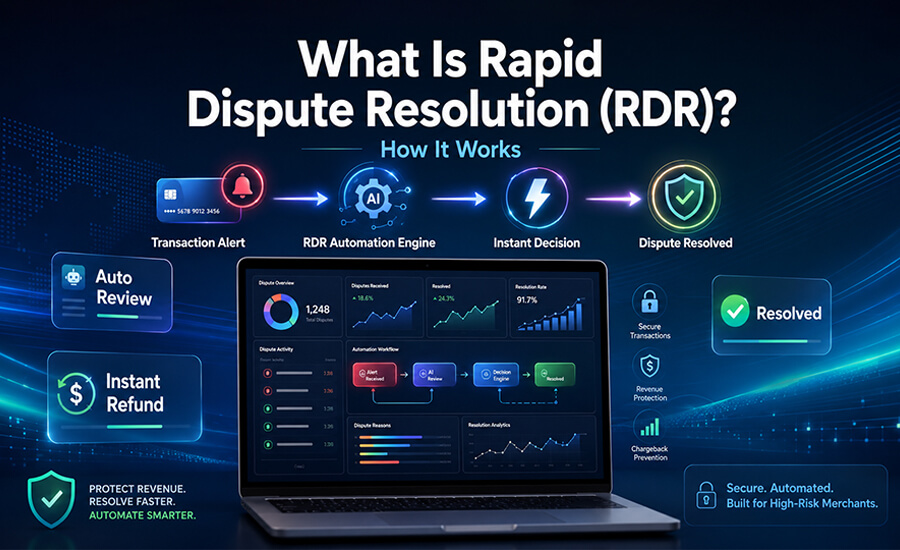
Chargebacks frustrate merchants. A customer disputes a credit card transaction, your bank gets involved, and suddenly you’re locked in a process that drags on for months. This is where rapid dispute resolution steps in. Rapid dispute resolution (RDR) is a streamlined chargeback process created by Visa that accelerates how disputes get resolved, reducing both the timeline and complexity that plague traditional chargeback systems. Instead of waiting 60-180 days for a resolution, RDR compresses this into just 20 days. For merchants processing payments, understanding RDR isn’t optional—it’s essential for protecting your revenue and managing your cash flow. Disputes cost businesses money through lost revenue, processing fees, and operational overhead. The faster you resolve them, the less damage they inflict. Solutions like Dispute Response make managing RDR cases straightforward by automating evidence submission, tracking timelines, and guiding merchants through the defense process. This guide explains what rapid dispute resolution is, how it works, why it matters for your business, and how to leverage it effectively.
Understanding Rapid Dispute Resolution
Rapid dispute resolution is a Visa initiative that changes how credit card chargebacks get handled. Rather than the long, complex back-and-forth that characterizes traditional chargebacks, RDR creates a faster, more efficient resolution pathway.
Think of it this way: Traditional chargebacks are like formal litigation. Both sides submit documents, request extensions, and appeal decisions over months. RDR is more like mediation—streamlined, quicker, and designed to reach resolution fast.
The system was created because everyone wins when disputes resolve quickly. Cardholders get clarity on whether they’re getting their money back. Merchants can move on from legitimate disputes rather than staying in limbo. Banks reduce administrative overhead. Visa maintains system integrity by catching fraud while respecting legitimate transactions.
RDR isn’t optional for merchants using Visa cards. If you process Visa payments, you’re potentially subject to RDR for eligible disputes. Understanding the mechanism means you can respond effectively instead of being caught off-guard when disputes arrive.
The Traditional Chargeback Process vs RDR
The traditional chargeback process takes time—sometimes 3-6 months. Here’s why it’s slow:
Traditional Chargebacks:
- Cardholder initiates dispute
- Bank contacts merchant
- Merchant submits response
- Bank reviews response
- Bank makes preliminary decision
- Cardholder can appeal
- Second round of submissions
- Final decision
This timeline frustrates everyone. Merchants lose visibility on their money. Cardholders wonder if they’ll get reimbursed. Banks manage endless document requests.
Rapid Dispute Resolution:
- Cardholder initiates dispute
- Merchant receives notice
- Merchant submits response
- Visa evaluates evidence
- Resolution issued
RDR compresses the process into a fraction of the time by eliminating the appeal stage and streamlining evidence evaluation.
How Rapid Dispute Resolution Works
RDR operates on a clear, linear process with specific deadlines at each stage. Understanding these deadlines is crucial because missing them means losing your case automatically.
Step 1: Dispute Initiation
A cardholder contacts their bank claiming a transaction is unauthorized, fraudulent, or not as described. The cardholder submits their reason code—a classification that explains why they’re disputing the charge.
Step 2: Merchant Notification
The cardholder’s bank (issuing bank) notifies the acquiring bank (your bank) that a dispute has been filed. This notification includes the dispute reason, transaction details, and the cardholder’s claim.
Step 3: Evidence Submission Window
You have 10 calendar days to submit evidence defending the transaction. This is your critical window. You must gather documentation proving the transaction was legitimate, that you delivered the product/service, and that the cardholder authorized the charge.
Step 4: Visa Review
Visa receives your evidence submission and evaluates it against the cardholder’s claim. Visa’s algorithms and analysts review both sides objectively. This stage takes 3-5 days.
Step 5: Final Decision
Visa issues a binding decision. Either the chargeback is upheld (cardholder gets their money back), or the chargeback is reversed (you keep the disputed amount). There is no appeal stage.
This simplicity is both RDR’s strength and its challenge. You get resolution quickly, but you also get only one opportunity to present your case.
Key Phases of the RDR Process
RDR consists of distinct phases, each with specific functions and deadlines.
Phase 1: Dispute Assignment
When a cardholder files a dispute, the issuing bank classifies it. RDR-eligible disputes are those without an appeal mechanism—meaning both sides must present their case in the initial submission.
Your acquiring bank notifies you of the dispute during this phase. You’ll receive details about the transaction, the reason code, and the cardholder’s claim.
Phase 2: Response Period
This is your only chance to defend the transaction. You have exactly 10 calendar days from the date you receive notice to submit evidence.
Your response might include:
- Proof of delivery or service completion
- Customer communication confirming the transaction
- Authorization records or signed agreements
- Shipping tracking information
- Digital receipts or invoices
- Customer account activity showing legitimate use
Quality matters enormously here. Visa evaluates evidence objectively. Generic responses lose. Specific, documented evidence wins.
Phase 3: Visa Evaluation
Visa reviews all submitted evidence. They consider:
- Is the evidence authentic and verifiable?
- Does the evidence prove authorization?
- Does the evidence prove delivery or service?
- Is the evidence relevant to the dispute reason code?
Visa applies consistent standards. They don’t favor cardholders or merchants—they evaluate evidence objectively.
Phase 4: Resolution
Visa issues a final decision. The transaction is either reversed (chargeback upheld) or you retain the funds (chargeback defended successfully). This decision is binding with no further appeal.
Who Uses Rapid Dispute Resolution
RDR applies to specific dispute categories. Not all chargebacks are eligible for RDR.
Also Read : fraud-vs-friendly-fraud-understanding-the-main-types-of-chargebacks
RDR-Eligible Reason Codes:
RDR applies to disputes falling under these Visa reason codes:
- Card Not Present (CNP) fraud disputes
- Authorization-related disputes
- Processing error disputes
- Clerical error disputes
- Certain “merchandise/service not as described” disputes
These categories represent about 60-70% of all Visa chargebacks, making RDR applicable to most merchant disputes.
RDR-Ineligible Disputes:
Some disputes remain outside RDR and use traditional processes:
- Fraud liability shift disputes
- Criminal fraud cases under investigation
- Disputes with potential regulatory implications
- Multiple disputes from the same cardholder
Your acquiring bank or payment processor determines whether a specific dispute qualifies for RDR. You’ll receive clear notification.
Who Benefits Most:
E-commerce merchants benefit most from RDR because they typically have strong documentation (email records, shipping tracking, digital receipts). Service-based businesses (consulting, coaching) may struggle because proving service delivery requires different evidence.
Benefits of RDR for Merchants
RDR creates significant advantages for merchants willing to defend their transactions properly.
Faster Cash Resolution
The most obvious benefit is speed. Getting resolution in 20 days instead of 180 days dramatically improves cash flow. You’re not wondering for months whether you’ll keep revenue. You know within three weeks.
This matters especially for small businesses where cash flow directly impacts operations. Knowing your actual monthly revenue earlier means better planning, faster reinvestment, and reduced stress.
Reduced Administrative Burden
Traditional chargebacks demand multiple submissions, appeals, and follow-ups. RDR requires one response. You prepare evidence once, submit it once, and await resolution. This simplicity saves staff time and reduces the back-and-forth.
For merchants processing thousands of transactions monthly, this efficiency compounds. You’re not managing endless chargeback timelines simultaneously.
Lower Cost Per Dispute
Each chargeback costs merchants money—not just the disputed amount, but also processing fees ($15-$100 per dispute). Faster resolution means you know costs earlier and can budget accordingly.
Additionally, you’re not paying staff hours to manage long, drawn-out disputes. The simpler process saves operational expense.
Clearer Process and Rules
RDR has explicit rules and deadlines. You know exactly what’s expected and when decisions will be made. This clarity removes ambiguity that plagues traditional chargebacks.
You can train staff on the RDR process because it’s consistent and predictable. There are no surprise appeal stages or unexpected extensions.
Data You Can Use
RDR decisions provide feedback about what evidence worked. You learn which documentation is most compelling. This information helps you improve your evidence submission practices for future disputes.
Challenges and Limitations
RDR isn’t perfect for every situation. Understanding limitations helps you manage expectations.
No Appeal Stage
RDR’s biggest limitation is also one of its features—there’s no appeal. Once Visa decides, that’s final. If Visa’s evaluation seems flawed or if new information emerges, you can’t request reconsideration.
This creates pressure on the initial response. You must include all relevant evidence in your first submission. Missing evidence in your initial response means losing your case permanently.
Tight Deadlines
Ten days sounds reasonable until you consider business realities. If a dispute lands on Friday before a holiday weekend, you effectively have less time. If your customer service team is small, gathering evidence quickly might be difficult.
Merchants must establish processes to respond rapidly. Ad-hoc, reactive approaches fail with RDR.
Evidence Requirements Are Strict
Visa has specific standards for what qualifies as acceptable evidence. A customer email saying “I approve this charge” might not be sufficient if it lacks timestamps or transaction details. You need documentation that meets Visa’s evidence standards.
Generic responses lose consistently. “The customer authorized this” without documentation fails. You need specific proof.
Not Ideal for Service Businesses
Service businesses struggle with RDR because proving service delivery is harder than proving product delivery. If you’re a consultant, how do you document service completion? Email threads and invoices help, but they’re weaker evidence than shipping tracking.
This doesn’t mean service businesses can’t succeed with RDR, but they need stronger documentation systems.
Visa’s Decision is Final
Unlike traditional chargebacks where bank review can reverse preliminary decisions, RDR decisions are binding. You can’t request additional review. Your evidence quality determines your outcome completely.
Also Read : losing-money-to-chargebacks-stop-the-damage-today-with-these-simple-fixes
Documentation Requirements
Winning RDR cases hinges on documentation quality. Visa evaluates evidence against strict criteria.
Authorization Documentation
You must prove the cardholder authorized the transaction. Acceptable evidence includes:
- Signed contracts or agreements
- Email confirmations from the cardholder’s email address
- Account creation timestamps
- IP address logs showing cardholder device used for transaction
- Password confirmation matching cardholder’s registered password
For card-not-present transactions, authorization is harder to prove. Payment processor records showing successful card verification (CVV match, AVS match) help but aren’t sufficient alone.
Delivery or Service Documentation
You must prove you fulfilled your obligation. For physical products:
- Shipping tracking numbers
- Delivery confirmation with signature
- Package weight and dimensions
- Carrier scans showing package progression
For digital products:
- Email confirmation of delivery
- Download logs with timestamps
- Software license activation records
- Account access timestamps
For services:
- Email communications with customer
- Project completion documentation
- Invoices with service descriptions
- Calendar/meeting records
- Work deliverables
Transaction Details
Documentation must match your evidence to the disputed transaction specifically. Generic evidence fails. Visa needs proof related to this specific transaction amount, date, and cardholder.
Your evidence must include:
- Transaction amount and currency
- Transaction date
- Merchant name and reference number
- Cardholder name and account (if applicable)
- Specific product/service description
Communication Records
Customer communications strengthen your defense. Email exchanges, support tickets, and messages showing the cardholder’s awareness of the transaction support your case.
However, communications must be genuine. Fabricated or altered documentation triggers fraud investigation and can result in merchant account termination.
Best Practices for RDR Defense
Successful merchants develop systems to defend transactions effectively.
Establish Evidence Gathering Processes
Create workflows to capture evidence automatically. When a transaction occurs, systems should:
- Log authorization details
- Record customer communication
- Track shipment/delivery
- Archive email confirmations
- Store digital receipts
Automation reduces the scramble when disputes arrive.
Respond Quickly
Don’t wait for the deadline. Respond within 2-3 days if possible. This gives Visa time to process your evidence thoroughly and shows you take disputes seriously.
Be Specific and Detailed
Generic responses fail. Instead of “Customer authorized this transaction,” provide: “Customer opened an account on [date] using [email], verified their identity with their passport, and placed this order at [timestamp]. We shipped via [carrier] with tracking [number], and delivery confirmation shows delivery at [address] on [date].”
Organize Evidence Logically
Present evidence clearly. Use numbered exhibits. Explain how each piece of evidence supports your position. Help Visa understand your case quickly.
Verify Evidence Authenticity
Before submitting, verify all evidence is legitimate, unaltered, and genuine. Tampered evidence doesn’t just lose cases—it can trigger fraud investigations and merchant account termination.
Include Customer Communication When Available
If the customer acknowledged the transaction, include that communication. It’s powerful evidence that the person with the card authorized the charge.
Don’t Oversub submit
Include relevant evidence, but don’t overwhelm Visa with irrelevant documents. Too much information dilutes your strongest evidence. Quality over quantity wins.
How Dispute Response Helps
Managing RDR cases manually is possible but inefficient. Dispute Response provides a platform specifically designed for RDR case management.
Automated Case Tracking
Dispute Response automatically tracks all dispute deadlines. You’re notified when a new case arrives and warned as the response deadline approaches. This automation prevents missed deadlines that automatically lose cases.
Guided Evidence Collection
The platform guides merchants through required evidence for each reason code. Rather than guessing what Visa needs, the system shows exactly what documentation strengthens your defense.
Templates and Frameworks
Dispute Response provides templates for common dispute scenarios. You’re not reinventing responses each time. Templates accelerate evidence preparation while ensuring comprehensive responses.
Document Organization
The platform organizes submitted evidence logically. When Visa reviews your response, they see clear, organized documentation rather than scattered files. Organized responses convert better.
Timeline Management
Dispute Response tracks key dates automatically. Submission deadlines, decision dates, and appeal windows (where applicable) appear on dashboards. This prevents costly deadline misses.
Performance Analytics
The platform tracks your RDR success rate by reason code. You see which evidence types work best for your business. This data drives continuous improvement in your defense strategy.
Integration with Acquiring Bank
Dispute Response integrates with major acquiring banks, automating dispute notifications and evidence submissions. This integration reduces manual administrative work significantly.
Team Collaboration
Multiple team members can access and contribute to cases simultaneously. Customer service, operations, and management collaborate efficiently on RDR responses.
CONCLUSION
Rapid dispute resolution fundamentally changes how merchants defend transactions. Instead of months of back-and-forth, RDR delivers resolution in 20 days with clear rules and straightforward processes. This speed is advantageous for prepared merchants—those with documentation systems and evidence-gathering workflows.
Understanding RDR means knowing your obligations: respond within 10 days with specific, organized evidence. Missing deadlines loses cases automatically. Weak documentation loses cases consistently. But merchants who embrace RDR and implement proper defense systems see better outcomes and faster cash resolution.
The key is preparation. Establish processes to capture evidence automatically. Create workflows to gather and organize documentation quickly. Train your team on response requirements. When disputes arrive—and they will—you’ll respond effectively rather than scrambling.
Platforms like Dispute Response remove the operational friction from RDR. They automate deadline tracking, guide evidence collection, organize documentation, and provide analytics on what works. Rather than managing RDR manually, successful merchants use technology to handle the administrative complexity.
Whether you’re managing RDR cases independently or with Dispute Response, understanding the process puts you in control. You’re not victim to the chargeback system—you’re an active participant defending your transactions effectively. That’s how you protect revenue, maintain cash flow, and build a sustainable business.