Chargeback Management Services - Dispute Response Jun/ 19/ 2026 | 0
By the time a chargeback hits your merchant account, you’ve already lost.
The money is gone. The dispute fee — anywhere from $20 to $100 — is charged on top of it. Your chargeback ratio ticks upward. And if it happens enough times, your payment processor starts asking uncomfortable questions.
Here’s what most merchants don’t realise: the card networks built an exit ramp before all of that happens.
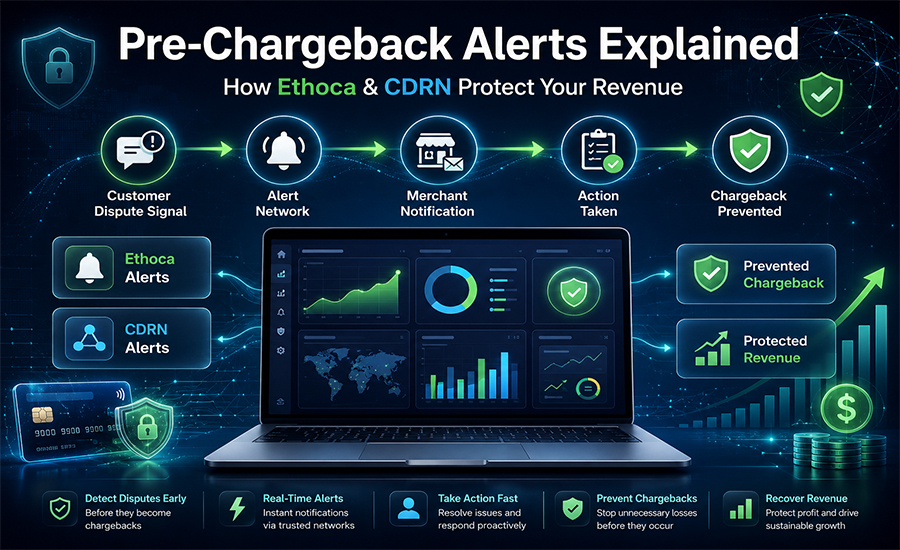
It’s called a pre-chargeback alert — a notification that fires the moment a cardholder contacts their bank to dispute a charge, before that dispute becomes an official chargeback. You get a short window to act. Issue a refund, resolve the issue, and the dispute disappears. No chargeback. No fee. No ratio damage.
The two dominant networks that make this possible are Ethoca (owned by Mastercard) and CDRN (owned by Visa). Together, they cover the vast majority of card transactions globally — and they may be the single most impactful tool you can add to your chargeback prevention stack in 2026.
This guide explains exactly how both systems work, how they compare, and how to use them to protect your revenue before disputes spiral out of control.
Why Chargebacks Are More Dangerous Than Ever in 2026
Before diving into the solutions, it’s worth understanding the scale of what you’re dealing with.
According to Mastercard’s 2026 research with Datos Insights, global chargeback volume is expected to reach 359 million transactions annually by 2029 — a 37% increase from 2025. In the US alone, chargeback volume is estimated to hit 146 million disputes at a value of $15.3 billion this year.
And the cost per dispute is staggering. Mastercard’s own data shows that each chargeback costs merchants an average of $128 in third-party fees and internal costs. For mid-market ecommerce businesses, that figure climbs closer to $315 per dispute when you factor in lost goods, representment labour, and the operational overhead of fighting each case.
The maths is brutal: for every $1 you lose to a chargeback, you’re actually absorbing $3.75 to $4.61 in total costs. That’s not a typo — that’s a 37% increase from five years ago.
Making things worse, Visa tightened its Visa Acquirer Monitoring Program (VAMP) thresholds in April 2026, dropping the “excessive” merchant threshold from 2.2% down to 1.5%. If your chargeback ratio crosses that line, you face fines, processing restrictions, and potentially losing your merchant account entirely.
The window to stay compliant is narrowing. Pre-chargeback alerts are one of the most effective ways to stay inside it.
What Is a Pre-Chargeback Alert?
A pre-chargeback alert is exactly what it sounds like: an early warning system.
When a cardholder calls their bank or card issuer to dispute a transaction, the issuer can send a notification through an alert network — either Ethoca or CDRN — before formally processing the chargeback. That alert lands with you (or your alert provider) within minutes to hours.
The alert contains the transaction details you need to identify the order: the transaction amount, date, card number (partially masked), and the reason the cardholder is disputing it.
You then have a short window — typically 24 to 72 hours — to respond. If you issue a refund or confirm a cancellation within that window, the dispute is resolved. The chargeback never gets filed. Your ratio stays clean. Your reputation with your processor stays intact.
If you miss the window, the dispute proceeds through the standard chargeback process, and you’re back to fighting it the hard way.
It sounds simple, and conceptually it is. The complexity lies in the two separate networks that deliver these alerts, how they differ, and how to make sure you’re covered across both.
Ethoca Alerts: How They Work
Ethoca was founded in 2005 and acquired by Mastercard in 2019. It operates one of the two dominant pre-chargeback alert networks globally.
What Ethoca covers:
Ethoca primarily covers Mastercard-branded transactions and has expanded to cover roughly 95% of Mastercard transactions globally. It also covers approximately 50% of transactions from other card schemes, including some Visa transactions, through participating issuers.
Because Mastercard owns Ethoca, the network has particularly deep issuer participation for Mastercard cards. If a significant portion of your transaction volume runs on Mastercard, Ethoca is non-negotiable.
How the alert process works:
- A cardholder contacts their issuing bank to dispute a charge
- If the issuer participates in the Ethoca network, they send an alert through the Ethoca system
- The alert reaches your chargeback management provider (like Dispute Response) within minutes
- Your team receives the transaction details and has 24 to 48 hours to respond
- A refund is issued directly to the cardholder
- The dispute is resolved — no formal chargeback is filed
One important note: Ethoca alerts require action. The alert fires, but the refund doesn’t happen automatically unless you have automation set up. You or your provider needs to act on each alert within the response window.
What Ethoca also offers: Consumer Clarity
Beyond the alert service, Ethoca offers a product called Consumer Clarity (also known as Order Insight for Visa). This sends digital receipts and transaction details — including merchant name, logo, and purchase details — directly to cardholders when they query a transaction through their banking app.
Many chargebacks happen simply because a customer doesn’t recognise a charge on their statement. Consumer Clarity resolves that confusion before it becomes a dispute. For merchants with vague or confusing billing descriptors, this alone can dramatically reduce dispute volumes.
Also read : rapid-dispute-resolution-rdr-how-it-works
CDRN (Cardholder Dispute Resolution Network): How It Works
CDRN stands for Cardholder Dispute Resolution Network. It’s a product of Verifi, a company acquired by Visa in 2019. Where Ethoca is Mastercard’s alert network, CDRN is Visa’s equivalent.
What CDRN covers:
CDRN primarily covers Visa transactions, with particularly strong issuer participation in the United States. It does not currently offer the same global reach as Ethoca, but for US-based merchants processing significant Visa volume, it’s an essential component of any prevention strategy.
How the CDRN alert process works:
- A cardholder contacts their Visa card issuer to dispute a transaction
- If the issuer is enrolled in CDRN, they pause the dispute and send an alert to the merchant
- The merchant receives the alert with transaction details and dispute reason
- The merchant has up to 72 hours to process a refund manually
- If the refund is confirmed within the window, the dispute is closed
- The chargeback is never formally filed
The key distinction here is the word manually. Unlike some automated solutions (such as Visa’s RDR product, which can process refunds automatically based on pre-set rules), CDRN requires a human to act on each alert. That’s workable at low volumes. At scale, it creates real operational risk — a missed alert due to a busy day or overlooked email means a preventable chargeback slips through.
Ethoca vs CDRN: Side-by-Side Comparison
Both networks do the same fundamental thing — they interrupt the chargeback process before it becomes official. But they differ in important ways that affect how you use them.
| Feature | Ethoca | CDRN (Verifi) |
| Owner | Mastercard | Visa |
| Primary card coverage | Mastercard | Visa |
| Geographic reach | Global | Primarily US |
| Response window | 24–48 hours | Up to 72 hours |
| Processing | Manual (unless automated) | Manual |
| Automation option | Available via providers | RDR available separately |
| Fee per alert | ~$30–40 per alert | ~$30–40 per alert |
| Issuer network | Strong in EU, Asia, Canada | Strong in US |
| Consumer Clarity | Yes | Order Insight (Visa) |
The most critical takeaway from this table: you need both.
Ethoca covers your Mastercard transactions. CDRN covers your Visa transactions. There is no single network that covers both completely. Merchants who enrol in only one are leaving a significant portion of their transaction volume exposed.
As one industry analysis noted, combining Ethoca and CDRN delivers coverage across roughly 95% of issuer participation for merchants with diversified card acceptance. Relying on just one network leaves gaps — and gaps mean chargebacks.
Also Read : stop-chargebacks-before-visa-puts-your-business-on-the-watchlist
The Real Cost Comparison: Alert Fee vs Chargeback Cost
One of the most common objections merchants raise about alert networks is the cost. At $30–40 per alert, it can feel like an added expense on top of an already frustrating problem.
Here’s the maths that should settle that question once and for all.
Without a pre-chargeback alert:
- Lost transaction revenue: $100 (example)
- Processor chargeback fee: $20–$100
- Cost of lost merchandise (if physical goods): variable
- Representment labour if you fight it: $50–$150
- Increased processing rates from elevated ratio: ongoing
- Total real cost: $270–$450+ per chargeback
With a pre-chargeback alert:
- Alert fee: $30–40
- Refund issued: $100 (you return the transaction)
- Total cost: $130–140
You still lose the sale revenue in either scenario when you issue a refund. But you save the chargeback fee, the operational cost, the merchandise, and — most importantly — you protect your chargeback ratio from taking a hit.
At scale, the difference is enormous. A merchant receiving 50 chargebacks per month at $315 all-in cost is absorbing $15,750 per month in chargeback losses. Converting even 60% of those into pre-alert resolutions reduces that burden significantly, while keeping the chargeback ratio well below Visa’s VAMP threshold.
Who Benefits Most from Pre-Chargeback Alerts?
Pre-chargeback alerts aren’t equally valuable for every merchant. They’re most impactful for:
High-volume ecommerce merchants If you’re processing hundreds or thousands of transactions per month, chargebacks are a statistical inevitability. The higher your volume, the more alerts you’ll receive — and the more value each resolution creates by protecting your ratio.
Subscription and SaaS businesses Recurring billing is one of the leading triggers for chargebacks. Customers cancel subscriptions, forget about them, or don’t recognise the charge on their statement. Pre-chargeback alerts are often the fastest way to resolve these disputes before they pile up, since cancellation-related disputes are among the easiest to resolve with a simple refund or cancellation confirmation.
Digital goods and intangible product merchants Merchants selling software, memberships, digital downloads, or services face a unique challenge: they have limited physical evidence to present in a chargeback dispute. Prevention is far more valuable than fighting for these businesses, making alerts a particularly smart investment.
High-risk merchants approaching VAMP thresholds If your dispute ratio is climbing toward the 1.5% VAMP threshold, every chargeback you prevent is directly protecting your merchant account. At that stage, alert networks move from “nice to have” to genuinely business-critical.
Travel, hospitality, and entertainment merchants These sectors saw dramatic chargeback rate increases post-pandemic and continue to face elevated dispute volumes. With average chargeback values in travel reaching $450 per dispute, the ROI on alert networks is particularly compelling.
The Operational Challenge: Why You Need a Professional Alert Provider
Here’s the part that many merchants discover too late.
Managing Ethoca and CDRN alerts manually is genuinely hard to do well.
Each network runs on its own system, with its own portal, its own alert format, and its own response window. If you’re enrolled in both — which you should be — that means two sets of alerts arriving through two separate channels, with two different clocks ticking down.
Miss a CDRN alert because your team was busy? That 72-hour window closes and the dispute becomes a chargeback. Overlook an Ethoca alert over a weekend? Same outcome.
The failure modes are numerous: human error, team capacity limits, time zones, holidays, system downtime. Each failure converts a preventable alert into a formal chargeback.
This is why working with a dedicated chargeback management provider — rather than attempting to manage alerts in-house — makes practical sense for most growing merchants.
A professional provider handles both Ethoca and CDRN through a unified monitoring system, processes refunds within the response window, logs every action for compliance and reporting, and surfaces patterns in your dispute data so you can address root causes rather than just symptoms.
Pre-Chargeback Alerts vs Chargeback Representment: What’s the Difference?
These two solutions are often confused, but they address completely different stages of the dispute lifecycle.
Pre-chargeback alerts are prevention tools. They act before a chargeback is ever filed, giving you the opportunity to resolve the dispute proactively.
Chargeback representment is the process of fighting a chargeback after it has already been filed — gathering evidence, building a rebuttal, and submitting a compelling case to win the dispute back.
Both have a place in a complete chargeback management strategy:
- Use alerts to intercept disputes that can be resolved with a refund
- Use representment to fight chargebacks that are illegitimate, fraudulent, or where you have clear winning evidence
The practical distinction: alerts are most useful for cases of friendly fraud, cardholder confusion, or legitimate disputes you’re willing to refund. Representment is your tool when a customer makes a false claim, commits first-party fraud, or disputes a valid transaction in bad faith.
Relying on alerts alone means you’re routinely refunding cases you might have won. Relying on representment alone means paying preventable chargeback fees on disputes you could have resolved for less.
The strongest approach combines both, with alerts handling the volume of disputes that make sense to settle, and representment deployed strategically for cases worth fighting.
How to Get Started with Ethoca & CDRN Alerts
Setting up pre-chargeback alerts involves a few key steps:
Step 1: Choose your alert provider You can enrol directly with Ethoca and Verifi, or work with a chargeback management company that provides integrated access to both networks. An integrated provider simplifies the operational complexity significantly.
Step 2: Enrol and integrate The integration process is typically straightforward — most merchants can begin receiving alerts within 24 to 48 hours of enrolment. Your provider will need access to your transaction processing data to match incoming alerts to the correct orders.
Step 3: Establish your response workflow Define who handles alerts, how refunds are approved, and what happens if an alert arrives outside business hours. Automation at this stage removes human error from the equation.
Step 4: Monitor and analyse The real long-term value of an alert programme isn’t just in the disputes it prevents — it’s in the data it generates. Over time, patterns emerge: the same customers filing repeated disputes, specific products with higher dispute rates, geographic patterns in fraud. Use this data to improve your operations upstream and reduce dispute volume at the source.
Step 5: Combine with representment for complete coverage Enrol your alert programme alongside a representment strategy so you’re covered at every stage of the dispute lifecycle. Prevention handles the disputes worth settling. Representment handles the disputes worth fighting.
Frequently Asked Questions
Do I need both Ethoca and CDRN, or just one?
You need both if you accept both Visa and Mastercard. Ethoca covers Mastercard transactions; CDRN covers Visa transactions. Relying on only one leaves a large portion of your volume unprotected.
What happens if I don’t respond to an alert in time?
If you miss the response window, the dispute proceeds through the standard chargeback process. You’ll face the full chargeback fee, a hit to your ratio, and will need to fight the dispute through representment if you want to recover the funds.
Do alert fees count against my chargeback ratio?
No. Successfully resolving a dispute through an alert system means no formal chargeback is ever filed. Your chargeback ratio is unaffected, which is one of the most valuable benefits of the programme.
What’s the difference between CDRN and Visa RDR?
CDRN requires manual processing — your team must act on each alert within the window. Visa RDR (Rapid Dispute Resolution) is a newer, more automated solution that can refund disputes automatically based on rules you configure, without requiring manual review. Many merchants use both: RDR for high-volume, low-value disputes where automatic refunding makes sense, and CDRN for cases that warrant review.
Are alert fees charged even if I don’t respond?
Yes. Both networks charge a fee per alert issued, regardless of whether the merchant responds. This is why a reliable workflow or provider is important — paying for an alert you don’t act on means paying both the alert fee and the subsequent chargeback fee.
How quickly can I get set up?
Most merchants working with an established alert provider can go live within 24 to 48 hours. The integration process is designed to be lightweight so you can start receiving alerts and protecting your ratio quickly.
CONCLUSION
Pre-chargeback alerts are not a luxury for merchants who have “too many chargebacks.” They’re a fundamental layer of protection for any business that accepts card payments at volume.
Every chargeback that reaches your account carries a financial cost, a ratio cost, and a relationship cost with your processor. Pre-chargeback alerts — through Ethoca for Mastercard transactions and CDRN for Visa transactions — give you the opportunity to stop the majority of those disputes before they become any of those things.
The investment is straightforward: $30–40 per alert resolved is significantly less than the $128 to $450 all-in cost of a chargeback that proceeds through the full dispute process.
With Visa’s VAMP threshold now at 1.5% and Mastercard’s dispute monitoring tightening in parallel, 2026 is not the year to delay. Every month without alert coverage is another month of preventable chargebacks counting against your ratio.
Dispute Response integrates directly with both Ethoca and CDRN, providing unified monitoring across both networks so you don’t have to manage two separate portals with two separate deadlines. Our team handles the entire alert response process — from detection to refund — so you can focus on running your business.