Chargeback Management Services - Dispute Response May/ 21/ 2026 | 0
What Is Rapid Dispute Resolution RDR & How It Works
Payment disputes are one of the most painful parts of running an online business. A customer buys a product or service. Then, instead of contacting the merchant first, they call the bank. The bank starts a dispute. The merchant loses time, money, and sometimes the product too. Charming system, truly.
This is where Rapid Dispute Resolution RDR comes in. RDR is a chargeback prevention solution that helps merchants resolve certain disputes before they become formal chargebacks. It is mainly linked with Visa and Verifi. Verifi describes RDR as a pre-dispute resolution system built on the Visa network and Verifi platform. It uses a rule-based decision engine to resolve eligible disputes in real time, based on rules set by the seller.
For businesses that deal with high dispute volume, RDR can be a powerful tool. It can reduce manual work. It can lower dispute ratios. It can protect merchant accounts. Most importantly, it can stop many disputes before they turn into expensive chargebacks.
At Dispute Response, we help merchants understand and manage tools like RDR so they can protect revenue and reduce payment risk.
What Is Rapid Dispute Resolution RDR?
Rapid Dispute Resolution RDR is an automated pre-dispute solution. It allows merchants to set rules in advance. These rules decide which disputes should be automatically accepted and refunded before they become chargebacks.
In simple words, RDR works like an automatic filter.
When a customer contacts their bank about a transaction, the case may enter the pre-dispute stage. If the merchant is enrolled in RDR, the system checks the dispute against the merchant’s preset rules. If the case matches the rules, the customer is credited. The chargeback is prevented. The merchant does not need to manually respond to that case.
Visa says its Resolve solution uses a decision engine to make real-time decisions and can solve pre-dispute cases within 72 hours through seller-initiated refunds.
So, RDR is not exactly a chargeback fight. It is more of a chargeback prevention method. You are not submitting proof to win the dispute. You are choosing to refund selected cases automatically because fighting them may cost more than accepting them.
Also Read: American Express Chargeback: What It Means and How It Works
Why RDR Matters for Merchants
Chargebacks are not just refunds. They come with fees, penalties, lost products, admin work, and risk to the payment account. Too many chargebacks can damage a merchant’s relationship with processors and acquirers. In serious cases, the merchant account can be restricted or closed. Humanity built online shopping and then punished merchants with paperwork. Naturally.
RDR matters because it gives merchants more control at an earlier stage.
Instead of waiting for a chargeback to arrive, merchants can decide which cases should be resolved quickly. For example, a merchant may choose to auto-refund low-value transactions, duplicate billing claims, or disputes with low recovery chances.
Verifi states that RDR can automatically resolve Visa disputes using a customizable decision engine that credits the cardholder before a chargeback is initiated.
This helps merchants save time. It also helps reduce unnecessary dispute handling costs.
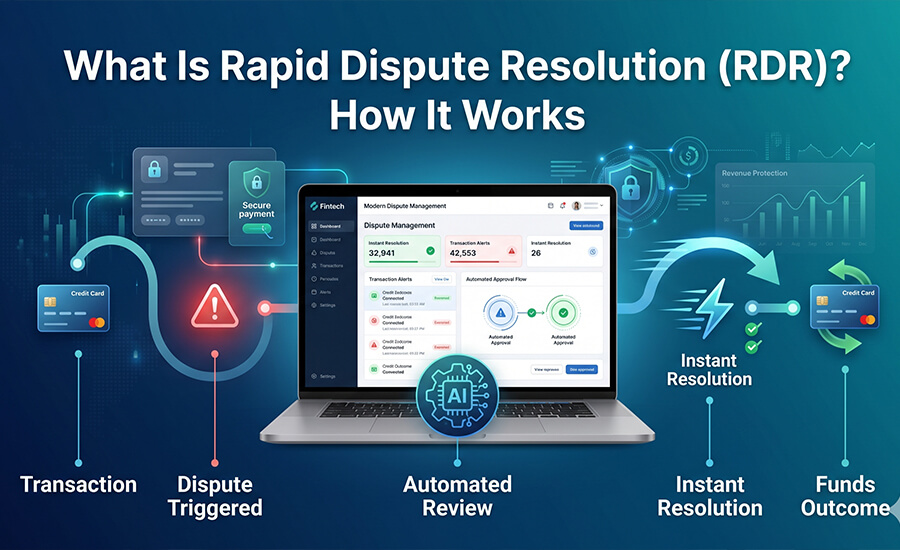
How Does Rapid Dispute Resolution Work?
RDR works through preset rules. These rules are created by the merchant or their dispute management provider.
Here is the simple process.
First, the customer contacts their issuing bank and raises a dispute inquiry. This happens before a formal chargeback is created.
Next, the dispute enters the Visa dispute system. Visa notes that issuers may use Visa Resolve Online, or VROL, to submit disputes to the Visa network. If the issuer is signed up for Resolve, disputes in VROL can be resolved in real time.
Then, the RDR decision engine checks the case. It compares the dispute details with the merchant’s rules.
If the dispute matches the rule, RDR accepts liability and triggers a customer credit. Verifi explains that when the pre-dispute details match the seller’s configured rules, a message is sent through the Visa network to the acquirer, allowing the customer to be credited and preventing the chargeback.
If the dispute does not match the rule, it may move forward into the normal dispute or chargeback process. At that point, the merchant may need to respond manually.
Also Read: 5 Factors That Determine How Often Merchants Win Chargeback Disputes
What Kind of Rules Can Merchants Set?
Merchants can set rules based on business needs. These rules help decide which disputes should be refunded automatically.
For example, a merchant may set rules based on:
- Transaction amount
- Dispute reason
- Product type
- Order category
- Customer risk level
- Market or region
- Recovery chance
Verifi states that sellers can create up to 10 rule scenarios and choose from 7 attributes, including pre-dispute transaction amount and condition code.
This is useful because not every dispute is worth fighting. A ₹500 dispute may not be worth hours of work, payment processor fees, and operational effort. A ₹50,000 dispute, however, may need full evidence review.
That is the whole point of RDR. It helps merchants stop wasting resources on disputes that are not worth the fight.
RDR vs Traditional Chargeback Response
Traditional chargeback response is reactive. The chargeback arrives first. Then the merchant collects proof. Then they submit a response. Then they wait. Then the bank decides. It is slow, boring, and somehow still expensive.
RDR is proactive. It works before the formal chargeback is filed.
In a traditional chargeback, the merchant may fight the case with evidence. This may include invoices, tracking numbers, delivery proof, login records, communication history, refund policy, and customer activity.
In RDR, the merchant does not fight selected cases. Instead, the merchant uses preset rules to decide which disputes should be refunded automatically.
This can be smart when the cost of fighting is higher than the transaction value.
Does RDR Help Reduce Chargeback Ratios?
Yes, RDR can help reduce chargeback ratios because eligible cases are resolved before they become chargebacks. Verifi states that disputes resolved before a chargeback starts do not count against Visa’s dispute ratio.
This is a major benefit for merchants. A lower dispute ratio can help protect payment processing stability.
However, merchants should not use RDR blindly. Auto-refunding everything may reduce disputes, but it can also reduce revenue. It may even encourage refund abuse if not managed properly.
That is why Dispute Response recommends using smart RDR rules. The goal is not to refund every dispute. The goal is to refund the right disputes and fight the cases that deserve a strong response.
Also Read: Stop Losing Money! How to Reduce Friendly Fraud in Your Business
Benefits of Rapid Dispute Resolution
The first major benefit is speed. RDR can resolve eligible disputes quickly. This creates a smoother customer experience.
The second benefit is lower workload. Your team does not need to manually review every small or low-value dispute.
The third benefit is cost control. Chargeback fees, admin time, and manual reviews can become expensive. RDR helps reduce these costs.
The fourth benefit is better dispute ratio management. Since resolved RDR cases may not count against the Visa dispute ratio, merchants can protect their processing health.
The fifth benefit is better focus. Your team can spend more time fighting valuable disputes instead of wasting effort on weak cases.
Who Should Use RDR?
RDR is useful for ecommerce businesses, subscription brands, digital product sellers, SaaS companies, online service providers, and high-volume merchants.
It is especially useful for businesses that see repeat dispute patterns. For example, if many disputes are low-value or linked to refund confusion, RDR can help.
It also works well for merchants with limited internal dispute teams. Instead of hiring more staff, they can use automation to reduce manual load.
But RDR is not perfect for every case. If your business sells high-ticket products, luxury goods, custom services, or physical items with strong delivery proof, you may want to fight more disputes instead of refunding them automatically.
Common Mistakes Merchants Make With RDR
The biggest mistake is setting rules too broadly. If every dispute gets refunded, the merchant may lose serious revenue.
Another mistake is not reviewing reports. RDR is automated, but it still needs monitoring. Automation without review is just a machine making expensive decisions while everyone claps.
A third mistake is ignoring root causes. If disputes are rising because of poor billing descriptors, unclear refund policies, weak customer support, or delayed shipping, RDR will not fix the real problem.
A fourth mistake is using RDR without a full dispute strategy. RDR should work with prevention alerts, refund policies, fraud screening, customer communication, and chargeback representment.
How Dispute Response Helps With RDR
Dispute Response helps merchants build a smarter dispute management system. We help businesses understand when to use RDR, how to set rules, and how to avoid over-refunding.
Our goal is simple. We help merchants reduce chargebacks, protect payment accounts, and recover more revenue.
We review dispute patterns. We identify weak cases. We suggest better rule logic. We also help merchants improve the full payment dispute process.
With the right strategy, RDR can become more than a refund tool. It can become part of a strong revenue protection system.
Final Thoughts
Rapid Dispute Resolution RDR is a powerful tool for merchants that want to prevent chargebacks before they happen. It uses automated rules to resolve eligible disputes at the pre-dispute stage. This helps save time, reduce costs, protect dispute ratios, and improve customer experience.
But RDR must be used carefully. It should not become a blind refund button. The best results come from smart rules, regular monitoring, and a complete chargeback strategy.
For merchants dealing with growing dispute volume, Dispute Response can help create a clear and practical RDR strategy. Because losing money to chargebacks is painful enough. Losing money because the rules were badly set is just self-sabotage with extra steps.