Chargeback Management Services - Dispute Response Feb/ 20/ 2026 | 0
For most business owners in the USA, the end of the day brings a familiar ritual: closing out the POS terminal and “sending the batch.” You see the total on the screen, but the journey those funds take before they hit your bank account is often a mystery. Understanding the settlement process is not just about accounting—it’s about mastering your cash flow and protecting your bottom line from unexpected hurdles.
At Dispute Response, we believe that a well-informed merchant is a more profitable one. In this guide, we’ll break down exactly how your acquirer settles your funds and what you need to know to keep your revenue flowing smoothly.
What is a Merchant Acquirer?
To understand settlement, we first have to answer a fundamental question: what is a merchant acquirer?
A merchant acquirer, also known as an acquiring bank or merchant bank, is a financial institution that partners with your business to process credit and debit card transactions. It acts as the essential intermediary between your business, the payment processor, the card networks (like Visa and Mastercard), and the customer’s issuing bank.
The acquirer is responsible for establishing your merchant account, facilitating the authorization and settlement of transactions, and—crucially—assuming the risk for fraud, disputes, and chargebacks. Without an acquirer, a business would have no way to securely receive funds from the global card networks.
The Three Stages of Getting Paid
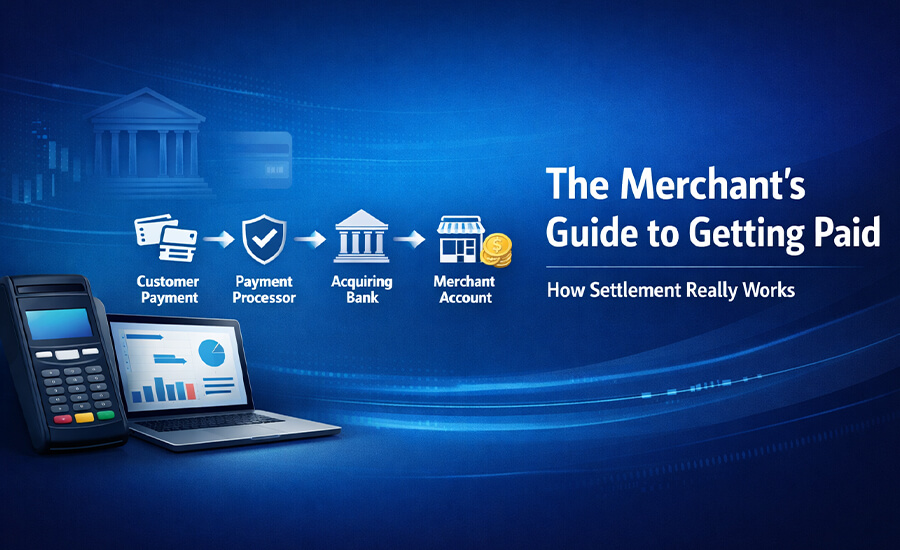
The path from a customer’s “tap” to your bank deposit involves three distinct stages: Authorization, Clearing, and Settlement.
1. Authorization: The “Yes” or “No”
When a customer swipes or taps their card, your acquirer sends an electronic request through the card network to the customer’s issuing bank. The issuer checks for available funds and fraud signals, then sends back an approval or decline in real-time.
2. Clearing: The Paperwork
Authorized transactions are stored in a “batch.” Most US merchants submit these batch files to their acquirer at the end of the business day, or even multiple times daily. During clearing, the acquirer validates the transaction details, calculates fees (like interchange), and sends the data to the card networks to claim the funds from the various issuing banks.
3. Settlement: The Money Move
Once the card network processes the transactions, the issuing bank remits the funds to the card network, which then transfers them to your acquirer. Finally, the acquirer deposits the funds into your business bank account. While some modern processors may offer faster settlement options, the typical cycle in the USA is 1–3 business days.
Choosing Your Style: Gross vs. Net Funding
In the USA, acquirers often give merchants a choice in how they receive their deposits. This choice can significantly impact your daily reconciliation.
- Gross Settlement: Your acquirer deposits the total amount of your daily sales batch into your account. At the end of the month, they deduct all processing fees in one lump sum. This is ideal for businesses that want to easily match their POS reports to their bank statements.
- Net Settlement: Your acquirer deducts your processing fees daily before depositing the remainder into your account. For example, if you process $1,000 in sales and your fees are $17, you receive $983. This helps businesses plan for daily cash outflows, but it can make monthly reconciliation slightly more complex.
Note: Implementation may vary depending on your processor, so confirm how your acquirer applies fees.
Why Settlements Get Delayed (and the Role of Disputes)
While modern cloud-based infrastructure is making settlement cycles faster, certain “red flags” can pause the process.
Acquirers are ultimately responsible for the transactions they process. If a merchant has a sudden spike in high-value transactions or an excessive ratio of chargebacks, the acquirer may move funds into a Reserve Account. This is a “safety net” account held by the bank to cover potential future losses from disputes or fraud.
Chargebacks are the primary credit risk for acquirers. Because a customer can dispute a charge for up to 120 days with most card networks, the acquirer remains liable if your business cannot cover the returned funds.
How Dispute Response Protects Your Settlement
Settlement is the lifeblood of your business, but it is fragile. A sudden wave of customer disputes doesn’t just cost you the sale; it can lead to your acquirer holding your funds in reserve—or even terminating your processing agreement.
This is where Dispute Response comes in. We specialize in helping US merchants manage the complex landscape of card scheme rules and chargeback management. By proactively managing your transaction data and providing robust responses to disputes, we help ensure your “fraud ratio” stays low and your settlement stays on schedule.
In the competitive US market, expedited fund availability is a strategic advantage. Don’t let disputes slow down your growth.
Ready to secure your settlement and master your merchant account? Contact Dispute Response today and let us handle the hurdles while you focus on sales.